
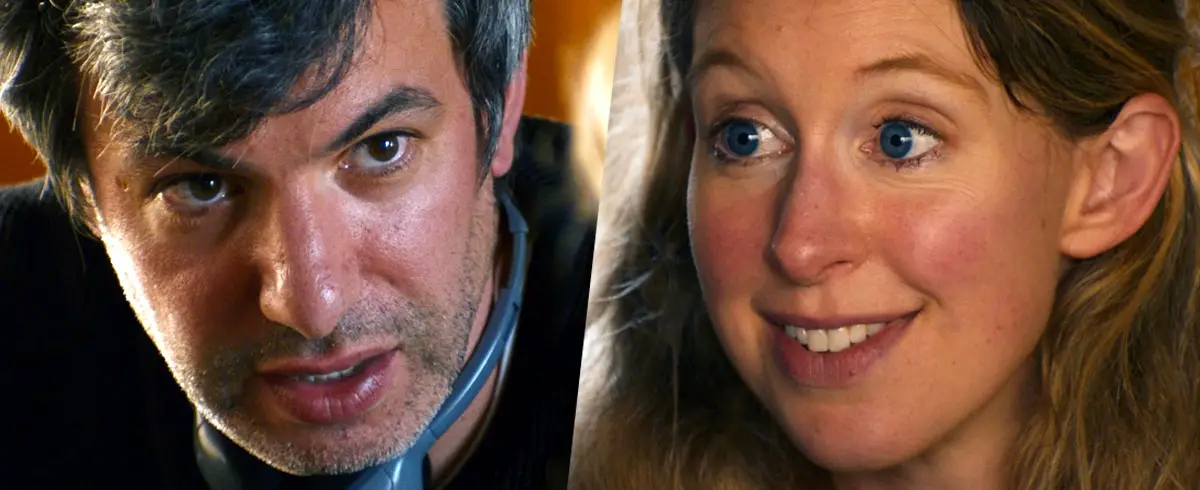

In You Can See Everything, a dude you may or may not know named Nathan Fielder hangs with Theranos founder and convicted felon Elizabeth Holmes and her husband and becomes consumed with understanding a woman who defies comprehension. Along the way he creates one of the most unique and enthralling documentaries of the decade.
Holmes was convicted of defrauding investors after raising billions on the promise of a machine that can analyze a single drop of blood for hundreds of illnesses, but if you’re reading this review you probably already know that. In You Can See Everything, cringe comedian Fielder and co-director Lance Oppenheim (who also directed this year’s Primetime) move in with Holmes and her newish husband Billie Evans a few weeks before she goes to prison. Fielder attempts to better understand what makes Holmes tick, why she refuses to accept guilt, and how culpable she actually is.
What unfolds is something that is hard to describe and even harder to critique without getting into the stuff that work best as surprises. What I will simply say is that You Can See Everything is a three-hour documentary that blurs the line between reality and lies, blends genre, and forces you to question everything you know.
Can. See. Everything. These are simple words, simple words to ignore. To overlook. But they weave their ways to the core of what this movie is all about, about the power of semantics, communication, and trust. And when those words are used by narcissists, deceivers, and visionaries, they can be twisted and skewed in immense ways.
You Can See Everything may be about Elizabeth Holmes, but it is just as much about those in her orbit and the effect that a woman like her can have on others. She recruited some of the top U.S. military minds onto her Board of Directors–how did these intelligent, restrained men not see what was happening under their noses? Nathan Fielder knows what she is going in, and yet spending day and night with her, watching her play with her children and break down crying at the thought of prison, talking with her in her home about innocuous things as she smiles at him with her big blue eyes and blond hair, he too is seduced by her.
You Can See Everything is about the impossible attempt to separate truth from lies, to tap into the mind of a woman who sees the world differently.
There is so much more I want to say, to dissect, and yet I’ll simply remark on the experience: the three hours fly by. It’s gripping from the first minutes thanks to Fielder’s awkward and sometimes funny demeanor, the focused close-ups that capture every flicker of emotion, every twitch of the eye, and Oppenheimer’s determined filmmaking that seems best suited for a thriller, not a documentary. When the movie pivots midway, when it sheds it seeming intentions to reveal other, grander goals, it leads to a collective gasp from the audience. This is no ordinary documentary.
I am not one to throw out words like masterpiece or perfect so early in a film’s release, but You Can See Everything is unlike any documentary I’ve ever seen before. Immensely entertaining, incredibly fascinating, and utterly absorbing, this film may come as close to perfect as a documentary can.
Review by Erik Samdahl. Erik is a marketing and technology executive by day, avid movie lover by night. He is a member of the Seattle Film Critics Society.